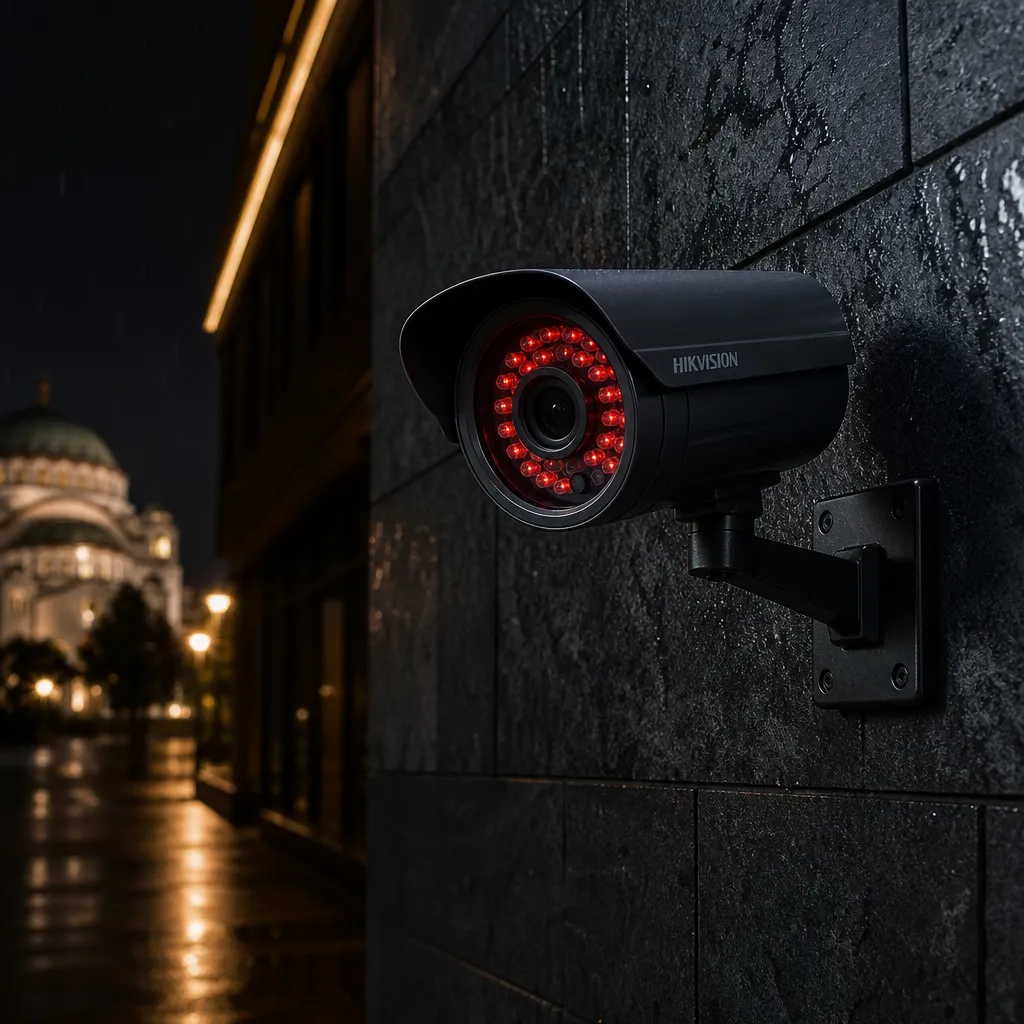
A camera that shows a face, not a blur.
Resolution alone decides nothing. Distance, lens, light and how many days the footage survives decide it — and that's a project question, not a shopping one.
When this makes sense
- You need to recognise a person or a plate, not just see that something moved.
- The footage has to hold up as evidence — to police, insurers or a court.
- More than one person needs to view the same picture from different places.
- The site has night traffic, a yard, a loading ramp or a till.
When it doesn't
- You only want deterrence at the entrance: one camera and a sign do that job.
- No one will ever open the archive. Buy fewer cameras and add an alarm instead.
- The real risk is at the fence, not inside the building — perimeter detection is cheaper and faster.
- There's no internet and no one to watch. Video without a viewer is just a disk.
How it works
- 01
What needs recognising
Detection, recognition or identification. Each needs a different pixel count on the target, and that decides the camera — not the label on the box.
- 02
Distance and lens
A wide lens covers the space and recognises no one; a long one recognises a face and sees nothing beside it. Position and focal length are decided on site, tape measure in hand.
- 03
Light and night
The IR range on a spec sheet is measured in clean air. Rain, fog and a bright light behind the target cut it down — WDR and mounting angle bring it back.
- 04
Where it's recorded and who watches
A recorder on site, VMS across locations, and a decision on who may open the archive. Without that part, the system has no owner.
What's in the system
- Cameras and lenseschosen by position, not by bundle
- NVR / recorderchannel count is the system's ceiling
- Surveillance diskssized by retention days
- VMS softwareanalytics and multiple sites on one account
- PoE switch and powerwith UPS, so the system survives a power cut
- Cabling and mountsthe part that decides how the install ages
- App and access rulesnamed accounts, logged viewing
Technical parameters
- Resolution
- 2 · 4 · 8 MP
- Lens
- 2.8–12 mm
- Frame rate
- 15–30 fps
- Compression
- H.265 / H.264
- Power
- 12 VDC / 24 VAC / PoE+
- Standard
- ONVIF
- Outdoor rating
- IP66 / IK10
Example — 120 m² shop
- Cameras
- 4 × 4 MP
- Positions
- entrance · till · aisle · stockroom
- Recorder
- NVR 4 ch. PoE
- Retention
- 30 days · ~0.7 TB
Illustrative example, not an offer.
Questions
Is 8 MP always better than 4 MP?
No. Higher resolution needs more light and more disk. At night a good 4 MP camera regularly beats a cheap 8 MP one, and it costs less to store.
Can an existing coaxial cable be reused?
Often yes. Over existing RG59 cable, an AHD/TVI system reaches 4 MP without breaking into walls. We check the cable's condition on the visit and say plainly if it's worth keeping.
How many days of footage should be kept?
Long enough for someone to notice the damage and ask for the footage. In retail that's usually 15 to 30 days; in a warehouse, one stock-take cycle.
Can we watch the cameras on a phone?
Yes, through a named account with logged access. Every viewing is recorded — exactly what you need when someone asks who opened the archive.
Who maintains the system after installation?
We do, under the service contract: lens cleaning, firmware, disk health, and checking that every camera still shows what it was placed to show.
Site visit and assessment are free of charge.
Site visit and assessment are free of charge · Mon–Fri 08:00–16:00