Stop the intruder at the fence, not in the house.
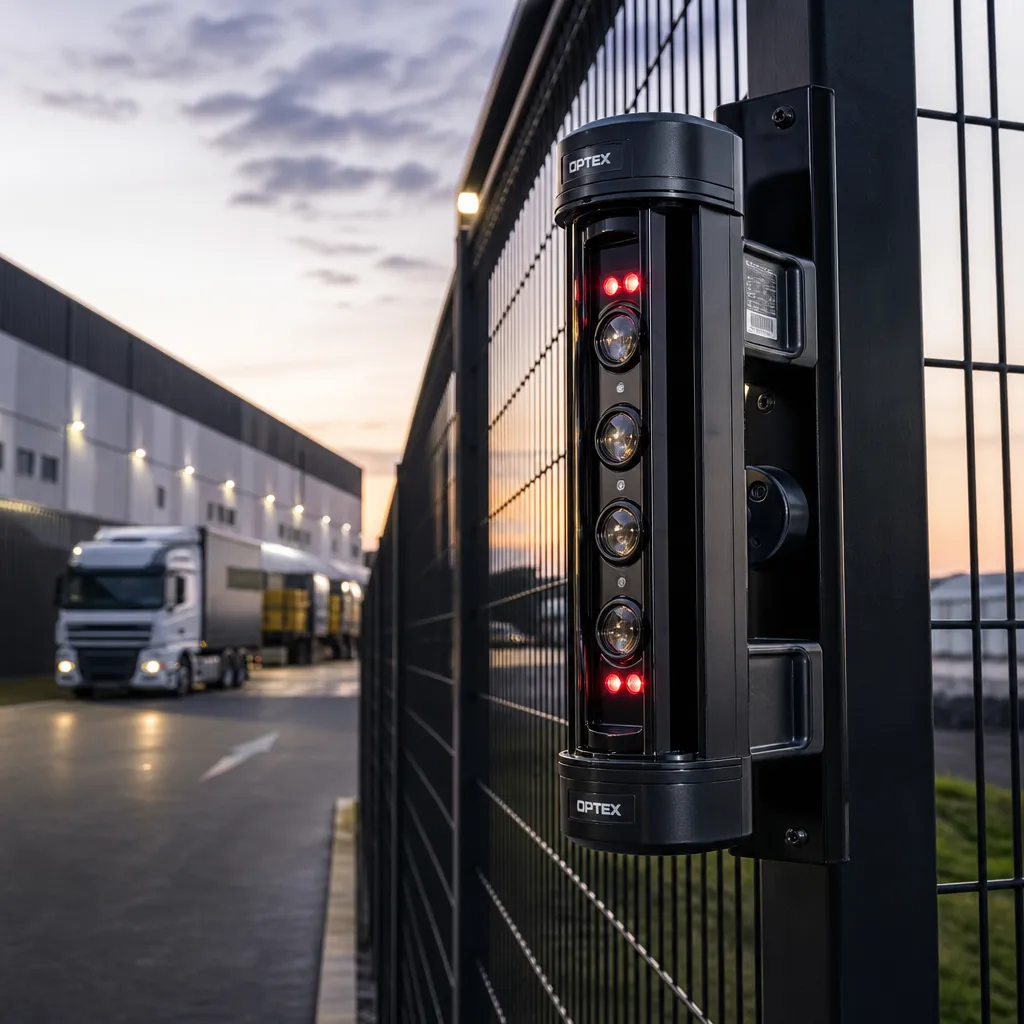
IR barriers along the property line, 100 to 700 metres. The alarm fires while the intruder is still outside, not once they're already in.
When this makes sense
- The yard, fence or plot is bigger than the building itself, giving an intruder time to reach the door.
- The site is empty at night and the response needs to start before someone climbs through a window.
- A warehouse or yard has a section cameras alone don't fully cover.
- There's already an indoor alarm, but no layer that acts before a break-in, not after.
When it doesn't
- The plot is small and the boundary runs along the house wall — indoor sensors and facade cameras do the job more cheaply.
- People, cats or tree branches cross the fence line daily — the barrier would trigger constantly.
- There's no yard or approach before the door — perimeter protection guards a boundary, and there isn't one here.
How it works
- 01
Survey and layout
We walk the fence and yard, measure straight runs, and look for places where the beam could be broken by a branch, gate or shadow.
- 02
IR barriers on the line
Transmitter/receiver pairs mount on posts or a wall, with a range of 100 to 700 metres per pair depending on terrain.
- 03
Fence logic
Barriers split into zones so the vehicle gate and the pedestrian path each have their own logic instead of one shared trip.
- 04
Alarm before the door
A broken beam sends the signal instantly, while the intruder is still at the boundary — before they reach a window or door.
- 05
Link to the monitoring centre
The signal reaches the same panel as the indoor alarm, verified on the camera covering that stretch of fence.
What's in the system
- IR transmitter and receiverpair per stretch
- Posts or mountsmatched to the terrain
- Zone controllersplits the fence into segments
- Cable and power12 VDC or 24 VAC
- Link to the alarm panelexisting or new
- Camera on the stretchfor verification
Technical parameters
- Range per pair
- 100 – 700 m
- Power
- 12 VDC / 24 VAC
- Zones
- matched to number of stretches
- Communication
- to the alarm panel, IP + mobile backup
- Weather resistance
- outdoor mount, IP66
- Monitoring
- 24/7 with verification
Example — warehouse yard, 3,000 m²
- Fence perimeter
- 220 m
- IR barriers
- 3 pairs, 100 m range
- Zones
- 3, one per fence stretch
- Monitoring
- 24/7 with verification
Illustrative example, not an offer. The final project follows a site visit.
Questions
Do IR barriers false-trigger on animals or branches?
Mounting height and angle are chosen so small animals pass under the beam; branches are cleared from the line during the site visit, and sensitivity is set per stretch.
Does the perimeter work in rain or fog?
Yes, but the catalogue range is measured in clear air — rain, fog and dust shorten it, so the project is designed with margin.
Does perimeter protection replace an indoor alarm?
No, it complements it. Perimeter protection stops the signal at the fence; indoor sensors cover whatever crosses that line.
Can perimeter protection connect to an existing alarm panel?
In most cases yes. We check how many free zones the panel has during the visit and say plainly if extra equipment is needed.
Site visit and assessment are free of charge.
Site visit and assessment are free of charge · Mon–Fri 08:00–16:00