The phone in your pocket, instead of a card someone forgets.
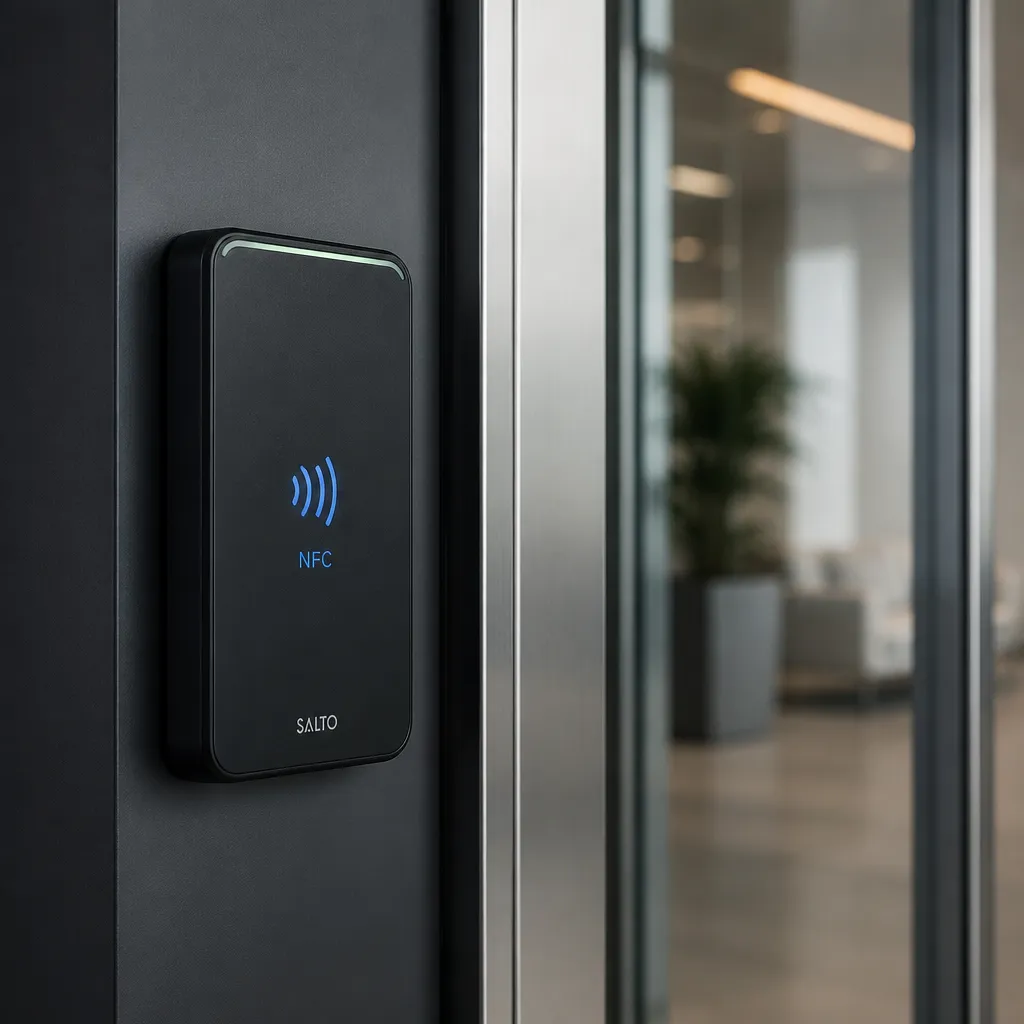
An NFC phone as identification for doors and attendance terminals. The device people already carry, no extra card needed.
When this makes sense
- Staff keep losing or forgetting cards, but always have their phone on them.
- The company already issues work phones or allows personal devices for identification.
- You need to grant or revoke access remotely and quickly, without physically handing over a card.
- The site already runs access control or time and attendance and wants an additional identification method.
When it doesn't
- Staff don't have smartphones, or the company bans their use on site.
- You want the cheapest possible identification for a small number of people — a plain RFID card is simpler.
- There's a strict requirement for biometric identification with no exceptions — fingerprint or face recognition is then the primary method.
How it works
- 01
Reader check
Access or attendance terminals need to support NFC; we check the existing equipment during the site visit.
- 02
Digital credential
Each user gets a digital credential tied to their phone, which the reader recognises the same way it reads a card.
- 03
Same access rule
An NFC phone fits into the same zones and time permissions as an RFID card or fingerprint.
- 04
Remote issue and revoke
A new credential is sent or deleted from the software, without physically handing over or collecting a card.
- 05
Dual use
The same phone opens the door and logs arrival at work, if access control and attendance are linked.
What's in the system
- NFC readerson doors or attendance terminals
- Credential-issuing softwarenamed accounts
- Door controller or terminalNFC-compatible
- Access control integrationoptional
- Time and attendance integrationoptional
- Backup identificationa card for when the phone is dead
Technical parameters
- Identification
- NFC phone
- Compatibility
- NFC-capable readers
- Reading range
- a few centimetres
- Backup identification
- RFID card
- Software
- same as access control / attendance
- Security
- digital credential, no physical card to clone
Example — office with 30 employees
- NFC readers
- 4 (entrance, 2 zones, attendance terminal)
- Users
- 30, all with an NFC credential
- Backup cards
- 5, for a dead phone
- Report
- monthly, per employee
Illustrative example, not an offer. The final project follows a site visit.
Questions
What if the phone's battery dies?
A backup RFID card is kept for that case, so no one is left without access because of a dead battery.
Is NFC identification more secure than a card?
A digital credential is harder to clone than a plain RFID card, and a lost phone is handled by revoking access instantly in the software.
Does NFC work for both access control and time and attendance?
Yes, if the two systems are linked — the same phone opens the door and logs arrival, with no extra step.
Do I need a special phone for NFC identification?
No, it works on most modern smartphones with an NFC chip — work-issued or personal, depending on your company's policy.
Site visit and assessment are free of charge.
Site visit and assessment are free of charge · Mon–Fri 08:00–16:00