A pass for the vehicle with permission, not for everyone.
A barrier arm, induction loop and remote or RFID identification — physical control of vehicle entry, separate from payment.
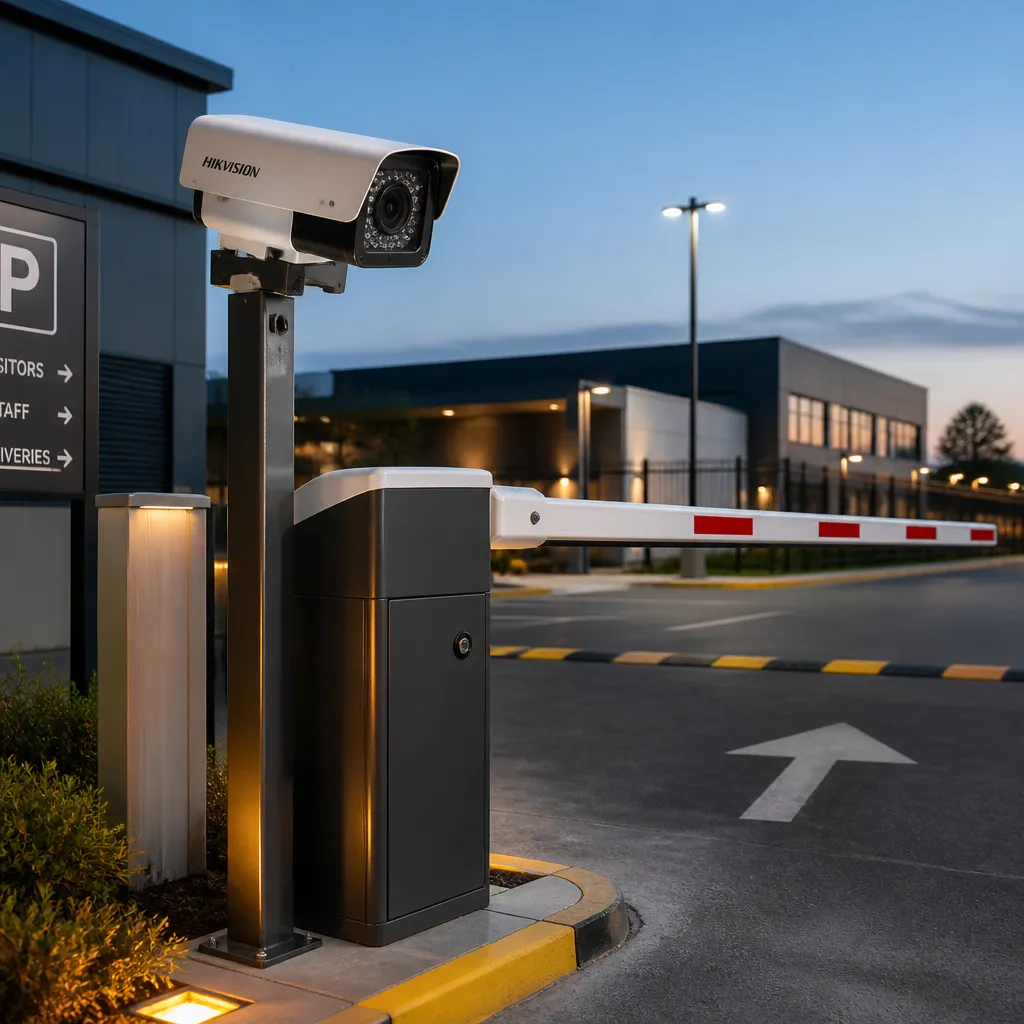
When this makes sense
- Vehicles need to be physically stopped at the entrance, not just logged after entering.
- Staff or residents carry a remote or RFID tag and need automatic opening without a guard at the gate.
- The site combines vehicle entry with a parking system or access control and needs a physical barrier linked to both.
- There's a risk of an unauthorised vehicle entering while the gate sits open or unsupervised.
When it doesn't
- Visual control or a single guard is enough at the entrance — no automatic barrier is needed.
- The space in front of the entrance is too narrow for the arm to operate safely and stop a vehicle reliably.
- The goal is only payment and logging, without physically stopping the vehicle — then a parking system with ANPR is enough, without a barrier.
How it works
- 01
Barrier type
We choose the arm based on passage width and traffic intensity — from a home driveway to constant flow at a company gate.
- 02
Induction loop
A loop in the road surface detects the vehicle and stops the arm lowering while a vehicle is in the passage.
- 03
Identification
A remote control, RFID tag or a signal from the ANPR camera triggers opening, based on the vehicle's permission.
- 04
Safety sensors
Photocells and end-of-travel sensors protect the vehicle and pedestrians from the moving arm.
- 05
Integration
The barrier links to a parking system for payment or to access control for staff permissions, but also runs standalone.
What's in the system
- Barrier armlength matched to passage width
- Drive mechanismelectric motor
- Induction loopvehicle detection in the passage
- Remote control or RFID tagper vehicle
- Photocellssafety during arm movement
- Controllerstandalone or linked to the parking system
Technical parameters
- Arm length
- up to 6 m, matched to passage width
- Power
- 220 V, 24 VDC or 230 VAC motor
- Identification
- remote · RFID tag · ANPR
- Vehicle detection
- induction loop
- Safety
- photocells, end-of-travel sensor
- Integration
- parking system, access control
Example — company gate with staff vehicles
- Barriers
- 2 (entry + exit)
- Induction loops
- 2, one in front of each barrier
- RFID tags
- 40, one per staff vehicle
- Integration
- staff access control
Illustrative example, not an offer. The final project follows a site visit.
Questions
Does the barrier work without a parking system for payment?
Yes, the barrier is a standalone line — it opens on a remote, RFID tag or a signal from access control, with no payment involved.
What stops the arm coming down on a vehicle?
The induction loop and photocells together detect the vehicle's presence and stop the arm moving until the passage is clear.
Can the barrier connect to existing access control?
Yes, the same RFID tag or card that opens a door can open the barrier too, if the systems are linked.
How many vehicles can the barrier handle at peak load?
It depends on the drive type, but a standard barrier opens and closes the arm in a few seconds — enough for normal traffic at a company gate.
Site visit and assessment are free of charge.
Site visit and assessment are free of charge · Mon–Fri 08:00–16:00